 English
 日本語
日本語 عربى
عربى Español
You pull a tray of roasted chicken out of a 200 °C oven and instinctively reach for the foil covering the dish. The tray needs mitts. The foil does not. Touching it feels like holding a sheet of paper that spent a few seconds near a warm radiator. The same material that just sat in the same oven as the tray feels practically harmless.
This is not luck. It is a predictable result of three physical properties working together: the low thermal mass of a thin foil sheet, aluminum's high thermal conductivity, and the foil's large surface area. In short, aluminum foil does not get hot to the touch because it holds very little heat energy, even at high oven temperatures. Here is how that works in detail.
Content
- 1 Thermal Mass: The Real Reason Your Fingers Survive
- 2 Thermal Conductivity: Spreading the Heat Thin
- 3 Surface Area and Convective Cooling
- 4 Cooling Curve: How Fast Foil Actually Cools
- 5 Why a Baking Tray Burns You but the Foil Does Not
- 6 Why Food Wrapped in Foil Stays Hot for a Long Time
- 7 When Aluminum Foil Can Actually Burn You
- 8 Shiny Side vs. Dull Side: Does the Surface Finish Matter?
- 9 Practical Kitchen and Business Implications
- 10 Aluminum Foil Heat Questions From Real Kitchens
Thermal Mass: The Real Reason Your Fingers Survive
Thermal mass determines how much heat an object stores at a given temperature. A heavy cast-iron skillet at 200 °C holds a large number of joules. A 0.02 mm sheet of foil at the same temperature holds almost none. The foil reaches oven temperature quickly, but the total energy stored in that thin sheet is minuscule.
When you touch the foil, heat flows into your finger. Because the foil's total heat supply is small, its temperature drops rapidly. Your skin never receives enough energy to reach the pain threshold. This is why the same 200 °C oven produces three different experiences: the air does not burn you instantly, the foil gives a mild warm sensation, and the steel rack causes severe injury.
The tray can hold hundreds of times more stored heat than a foil sheet of equal area.
Specific Heat Capacity and Foil Weight
Aluminum's specific heat capacity is 0.897 J/g·°C. That is actually higher than iron (0.449 J/g·°C), meaning a gram of aluminum needs twice the energy to warm up by one degree. But physical volume flips the advantage. A 30 cm × 30 cm foil sheet weighs about 2.4 grams. A comparable steel baking tray weighs roughly 900 grams. Multiplying mass by specific heat capacity gives the total heat capacity — the foil stores about 200 times less energy than the pan at equal temperature.
This fact is the foundation of safe handling with aluminum foil containers in commercial kitchens. A disposable aluminum foil container will feel warm but tolerable at the rim when lifted from the oven, whereas a steel pan of the same dimensions demands heat-resistant gloves.
Thermal Conductivity: Spreading the Heat Thin
Aluminum conducts heat at roughly 237 W/m·K. Copper reaches about 401 W/m·K; steel sits far lower at 45–50 W/m·K. High conductivity in a thin sheet means heat spreads almost instantly across the entire surface rather than pooling at the contact point. When your finger touches the foil, local heat dissipates sideways into the rest of the sheet within milliseconds. The result is a lower peak temperature at the point of contact.
This conductivity also explains why foil evenly distributes heat when wrapped around food. Local hotspots from an oven element do not stay local — they fan out across the surface. Meat wrapped in foil cooks more evenly for exactly this reason.
Where High Conductivity Helps and Hurts
High conductivity is a double-edged sword. It prevents contact burns from foil because heat dissipates too quickly. It also makes foil pans cool down significantly faster than cast iron once removed from the heat source, which is why ceramic and stoneware dishes stay hot much longer on the dinner table. On the other hand, the ability to drop temperature quickly matters in airline catering and large-volume food service operations, where portioned meals must reach safe handling temperatures within a defined window before being transferred to serving carts.
Surface Area and Convective Cooling
Heat leaves a hot object through convection, conduction, and radiation. In still air, convection dominates. A sheet of foil presents an enormous surface area relative to its mass — often exceeding 200 cm² per gram. Contact with room-temperature air strips heat efficiently. The 200 °C foil loses its stored energy within seconds of leaving the oven.
Compare that to a baked potato: dense, moist, and pulling heat from its core. The potato cannot shed heat from its interior, so it remains dangerously hot for minutes. The foil, with no interior to draw from, simply equilibrates with the surrounding air.
Cooling Curve: How Fast Foil Actually Cools
The graph below models a single sheet of foil at an initial oven temperature of 230 °C in 22 °C room air. Within the first 10 seconds, the foil surface drops below 60 °C — the approximate threshold for skin discomfort. Within 30 seconds, it falls to near room temperature.
This graph assumes a flat sheet in free air. Crumpled foil cools slower because trapped air pockets reduce convective contact. Foil pans with food inside cool much slower because food acts as a heat reservoir, which is useful for serving hot meals buffets and delivery applications.
Why a Baking Tray Burns You but the Foil Does Not
The tray and the foil may sit in the same oven, but they do not sit at the same energy level. A steel tray's thick walls store thousands of joules. When you touch it, energy flows continuously from the tray's interior into your skin. The tray barely cools during the contact. The foil's energy reserve, by contrast, is exhausted in a fraction of a second. Your nerve endings register a warm tick, not a burn.
High-Heat Foil Pans Have Similar Physics
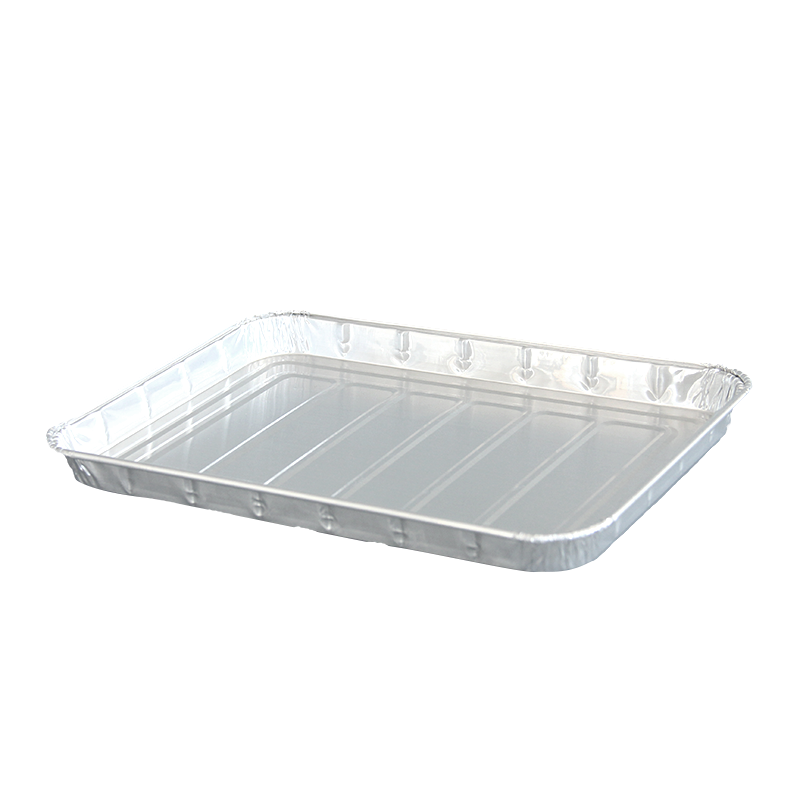
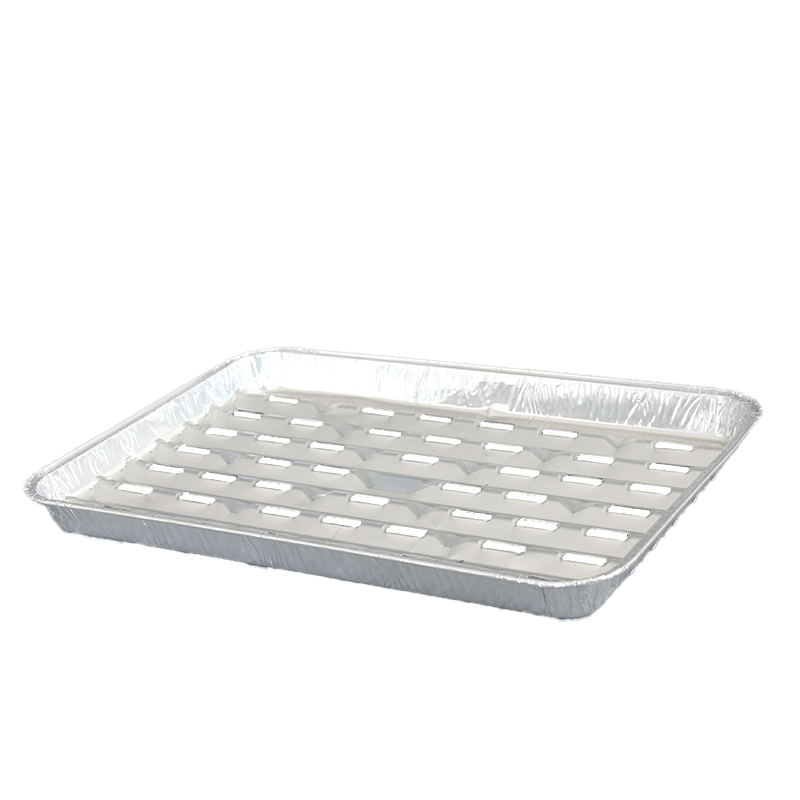
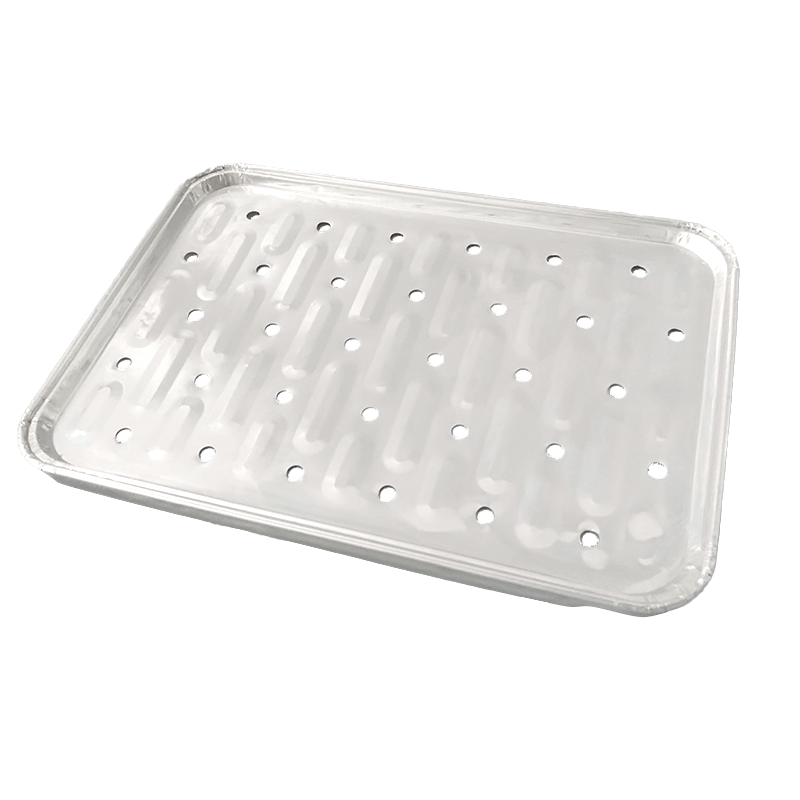
If the foil is formed into a rigid pan, the physics changes slightly but measurably. A deep embossed foil pan weighs 8–20 grams rather than 2 grams, and its rippled walls add structure that traps some heat. It still stores far less energy than a steel tray, but it can produce uncomfortable heat if you grip it firmly for several seconds. This is why food service operators use a folded rim or cardboard sleeve when handling foil trays in catering lines.
For cooking applications that call for prolonged contact with heat, such as a turkey roaster or a grill pan, the container design deliberately adds rim stiffness so that heat transmits through a smaller contact surface. A 5000 ml turkey roasting pan behaves differently from a flat sheet because the food inside maintains the pan's temperature at food-holding levels for extended periods.
Why Food Wrapped in Foil Stays Hot for a Long Time
Here is the apparent paradox: a foil sheet cools almost instantly, yet food wrapped in foil stays hot for twenty minutes. The resolution lies in the insulation mechanism. The foil does not keep the food warm because it stores heat. It keeps food warm because a wrapped packet blocks direct air flow and radiant heat escape. The aluminum layer reflects a portion of the food's long-wave infrared radiation back to the surface, while the air gap between the food and the foil acts as a convection barrier. The food's own thermal mass, not the foil, is the heat source.
The same principle governs how caterers use takeout delivery packaging. Foil lids on containers trap steam and slow evaporation, which keeps noodle dishes and barbecue portions pliable and warm during transport. In this context, the low thermal mass of the foil plays an essential role: it insulates without stealing heat from the food.
When Aluminum Foil Can Actually Burn You
Foil is safe to touch after a short moment, but it is not proof against burns. Several conditions raise the risk:
- Foil directly below a grill flame can exceed 400 °C. The metal itself degrades above 660 °C, but the moment you touch it, it can still transfer hundreds of joules if torn or bunched into a thick ball.
- Multiple folded layers, such as a foil pouch tightly wrapped around a roasted garlic bulb, store far more heat than a single sheet.
- Foil that has crumpled into a thick ridge can hold heat longer and cause a mild scald.
- Foil pans heated empty on a stovetop or under a salamander broiler reach temperatures above the safe-touch range because the rim is mechanically reinforced and thicker than standard foil.
A practical rule from commercial kitchen training: after removing foil from any heat source, wait 10–15 seconds before handling it with bare hands. For catering volumes, never lift a full foil tray by its edges for longer than a few seconds without a mitt.
Shiny Side vs. Dull Side: Does the Surface Finish Matter?
The shiny and dull sides come from the rolling process — two sheets are passed together through the final mill, and the inner faces contact each other while the outer faces contact rollers. In terms of heat retention, the emissivity difference between the sides is approximately 0.03 in the visible spectrum, which translates to a negligible difference in emissive heat loss. No practical difference in cooling time exists. Some chefs insist that wrapping with the shiny side facing inward reflects heat more effectively; measured differences fall below 1 % of total heat transfer and are undetectable in cooking.
The real parameter is surface finish versus contact. Tight contact conducts better than loose wrap; air gaps insulate. If the goal is to brown food quickly, wrap loosely. If the goal is moisture retention, wrap tightly.
Practical Kitchen and Business Implications
Understanding foil's low heat retention changes how professional kitchens select and handle cookware. In bakeries producing 650 loaves per shift, for example, aluminum loaf bread pans cool fast enough to be handled shortly after extraction, reducing the need for extra gloves and trays. Single-use foil catering trays simplify the cooling and packing process because the product itself drops below food safety holding temperature quickly when placed on stainless steel countertops.
What This Means for Commercial Buyers
Restaurants and catering services use aluminum foil containers not because the metal stays cold — it does not — but because its low heat capacity eliminates a range of operational problems:
- Faster lineup: boxes can be packed and transferred sooner after cooking.
- Lower burn risk: reduced storage of heat energy means fewer accidents.
- Energy efficiency: foil containers do not draw heat away from food the way thick-walled baking pans do, slightly reducing oven recovery times.
At Ningbo Aikang Aluminum Foil Technology Co., Ltd in Haishu District, Ningbo, we have built our product line around exactly these properties of aluminum foil. We produce disposable aluminum foil containers for baking, roasting, aviation catering, and takeout markets. Our turkey roasting pans, barbecue trays, loaf pans, and compartment containers are manufactured from food-grade 8011 and 3003 aluminum alloys with controlled rim profiles. The wire-reinforced rims keep the pan stable during transport while preserving the characteristic low heat retention that makes foil comfortable to handle. Our production facility runs multiple fully automatic lines that press containers from foil coils at up to several units per second, guaranteeing uniform thickness and consistent crimp strength. If you buy volume for a food service distribution business, OEM orders with custom sizes or printed outer packaging are available — email us at the contact page and our sales team will respond with capacity and price details.
We operate under a simple principle: sincerity and integrity. Since our founding, we have served clients in more than 30 countries, supplying food-grade aluminum foil products for baking and disposable catering. We believe clear communication and dependable delivery create a double-win situation for your company and ours. You can request free samples of our standard trays before committing to a production run.
Aluminum Foil Heat Questions From Real Kitchens
| Question | Short Answer |
|---|---|
| Why can I touch foil straight from the oven? | Its thermal mass is so small that the foil loses stored heat to your fingertip almost instantly. |
| Can foil containers go in an air fryer? | Yes, if they are food-grade, placed without touching the heating coil, and the basket size matches. Our containers handle 200 °C convection. |
| Is the dull side less safe for cooking? | No. The shiny/dull difference comes from the rolling process and does not create a meaningful heat difference. |
| Why does my foil tray stay hot longer than flat foil? | Rigid pans weigh more and the food inside transfers heat into the walls, delaying cooling. |