
 English
 日本語
 عربى
 Español

-
 01
Standard Catering Pan Sizes: Full, Half, Third and Quarter Pan Capacity Guide
Industry News-Ask three caterers what a full-size pan holds and you can get three different answers: 8 quarts, 13 quarts, 20 quarts. All three can be right. They are describing the same 12 by 20 inch pan at three different depths, which is exactly why catering pan sizes cause so much confusion at the ordering stage.
The short version comes first. Almost every catering pan sold in the United States is built on a single 12 x 20 inch footprint, and the size names — full, half, third, quarter, sixth, ninth — only describe how much of that footprint a pan occupies. Depth is a separate decision, and it is the one that changes capacity, unit cost, and how often your staff has to refill a pan in the middle of service.
Content
- 1 The short answer: four sizes cover most catering work
- 2 How the 12 x 20 inch system fills a well
- 3 Depths and capacities: why the published numbers disagree
- 4 US hotel pans and Gastronorm pans are close, not identical
- 5 Where disposable aluminum pans change the math
- 6 Who makes these pans
- 7 Frequently asked questions
- 7.1 Q1. What is the standard size of a catering pan?
- 7.2 Q2. How many servings does a full-size catering pan hold?
- 7.3 Q3. Can I use a half-size pan in a full-size steam table well?
- 7.4 Q4. What depth catering pan should I choose for a buffet line?
- 7.5 Q5. Are aluminum foil catering pans as strong as stainless steel pans?
- 7.6 Q6. Do foil steam table pans fit standard lids?
The short answer: four sizes cover most catering work
Full, half, third and quarter pans handle the overwhelming majority of buffet, banquet and steam table work. Sixth and ninth pans exist and are genuinely useful, but they are garnish, sauce and topping accessories rather than workhorses.
The reason is plain geometry. A full-size pan defines a fixed rectangular well, and every smaller size is a clean fraction of it. That means you can mix sizes inside one opening without adapter plates, and you can predict how many pans a given line will need before you buy anything.
| Pan size | Nominal top dimensions | Share of a full-size well | Common depths |
|---|---|---|---|
| Full | 12 in x 20 in | 1/1 (100%) | 2.5 in, 4 in, 6 in |
| Half | 12 in x 10 in | 1/2 (50%) | 2.5 in, 4 in, 6 in |
| Third | 12 in x 6 2/3 in | 1/3 (33%) | 2.5 in, 4 in, 6 in |
| Quarter | 10 in x 6 in | 1/4 (25%) | 2.5 in, 4 in, 6 in |
| Sixth | 6 2/3 in x 6 in | 1/6 (17%) | 2.5 in, 4 in |
| Ninth | 6 2/3 in x 4 in | 1/9 (11%) | 2.5 in, 4 in |
Share of a full-size 12 x 20 in steam table well
The pattern is easy to read: when depth is held constant, capacity scales with the footprint, so doubling the pan area roughly doubles what it holds.
How the 12 x 20 inch system fills a well
Because every size is a fraction of the same rectangle, a full-size well can be filled in several clean ways. These are the combinations that show up most often in working banquet kitchens:
- One full-size pan.
- Two half pans, side by side along the 20 inch length.
- Three third pans in a row.
- Four quarter pans in a two-by-two block.
- One half pan plus two quarter pans, which fills the same rectangle exactly.
Any combination that adds up to 12 x 20 inches works. Combinations that leave a gap do not: loose pans slide, and a sliding pan is how a chafing dish ends up with sauce in the water bath at the worst possible moment.
Depths and capacities: why the published numbers disagree
Standard depths are 2.5, 4 and 6 inches, with 1.25 inch, 2 inch and 8 inch pans available in smaller and specialty lines. Volume grows roughly in proportion to depth, yet the numbers on supplier charts often do not match each other, even for what looks like the same pan.
Three things cause the gap. First, some charts quote brim-full volume while others quote a working capacity. Chefs Resources, a culinary reference site, publishes both figures for steam table pans and notes that its 85 percent capacities represent what a pan holds when it can still be carried safely. Second, rounded corners and tapered walls reduce real volume compared with a straight-sided box. Third, some charts report quarts, others fluid ounces, and a few report servings of one specific dish.
Published capacity of a full-size 12 x 20 in pan by depth
8 qt2.5 in
13 qt4 in
20 qt6 in
A practical rule of thumb for a full-size pan: about 8 quarts at 2.5 inches deep, about 13 quarts at 4 inches, and about 20 quarts at 6 inches. In serving terms, caterers commonly plan 10 to 12 servings from a full-size pan of a saucy pasta and closer to 20 from a dense casserole, a figure that comes up repeatedly in catering forum discussions. The pan did not change; the food did.
US hotel pans and Gastronorm pans are close, not identical
European and many Asian kitchens work to Gastronorm, or GN, dimensions. The two families look similar on paper, but a GN pan will rarely drop into a US steam table well: a GN 1/1 pan measures 530 x 325 mm, roughly 20.9 x 12.8 inches, which is about eight percent longer than its US counterpart.
| US size | Nominal US dimensions | Nearest GN size | GN dimensions |
|---|---|---|---|
| Full | 12 in x 20 in | GN 1/1 | 530 x 325 mm |
| Half | 12 in x 10 in | GN 1/2 | 325 x 265 mm |
| Third | 12 in x 6 2/3 in | GN 1/3 | 325 x 176 mm |
| Quarter | 10 in x 6 in | GN 1/4 | 265 x 162 mm |
If your operation runs both, standardise on one family for anything that touches a steam table well, and keep the other family for oven and display use, where a few millimetres of clearance rarely matter.
Where disposable aluminum pans change the math
For off-site catering, pan choice is not only about capacity. Reusable pans have to be collected, trucked back, washed and stored, and stainless steel is heavy enough that one hundred full-size pans becomes a logistics problem on its own. Aluminum foil catering pans drop into the same 12 x 20 well, take the same lids, and travel from oven to holding cabinet to the client's table without a return trip.
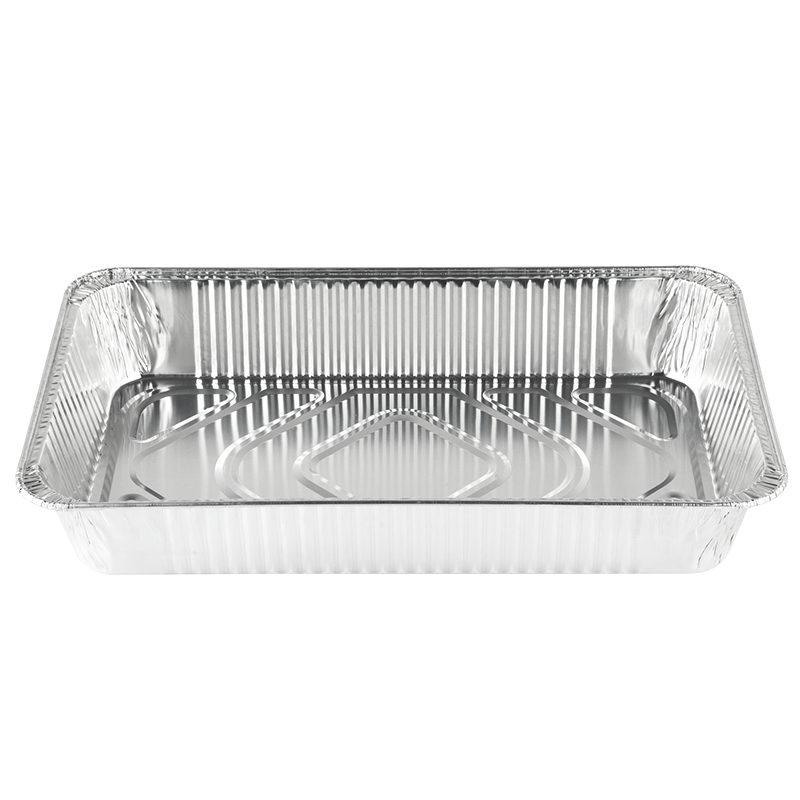 Full-Size Deep Aluminum Foil Steam Table Pan IK528Disposable aluminum foil full-size steam table pan with 9300 ml capacity, reinforced edges, full curl rim, and optional PS lid for off-site catering.View Product →
 Half-Size Deep Aluminum Foil Steam Table Pan IK325DAluminum foil half-size steam table tray with 3200 ml capacity, full curl rim, stackable design, and optional PS lid for buffets and medium gatherings.View Product →
Formed foil pans are drawn with a taper, so top-out dimensions run slightly under nominal, typically about an eighth to a quarter of an inch smaller per side, and the base is noticeably smaller than the rim. That taper is what lets pans nest for shipping and release cleanly from the mould. Buyers who need a specific fill volume should specify it in millilitres or quarts and confirm the pan against a sample, not against the size name alone.
Anatomy of a foil steam table pan
The same fraction logic applies to disposables. Two half-size foil pans fill one full-size well, three third-size pans fill the same opening, and a compartmented tray lets a single pan carry a main and two sides, which is why oblong and rectangular foil containers have become a standard format for delivered meal programs.
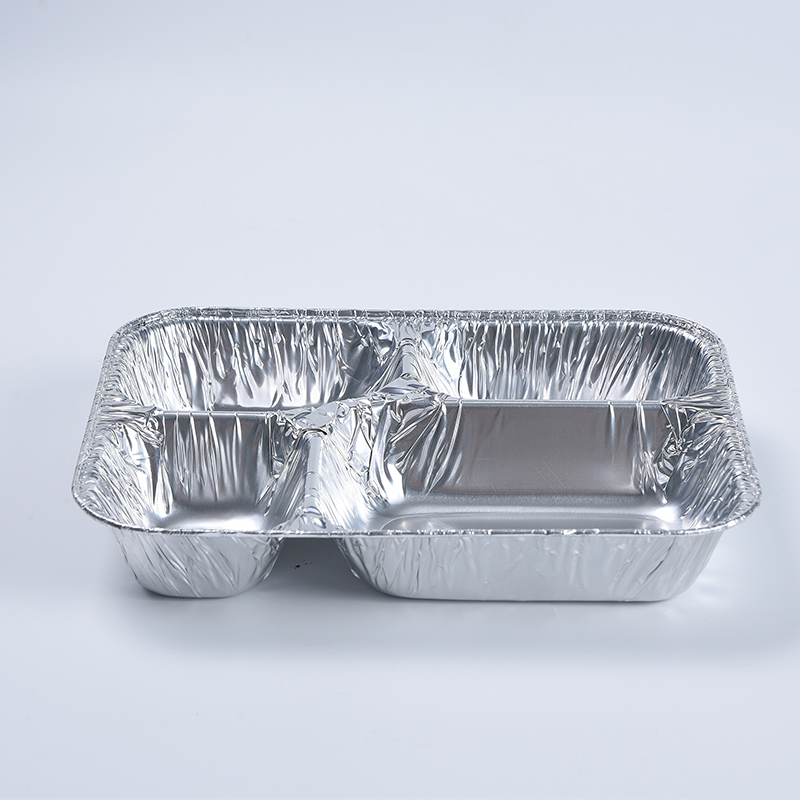 Oblong 4-Compartment Disposable Aluminum Foil Tray 227-4Disposable aluminum foil tray with four compartments, 880 ml volume, full curl rim, and recyclable design for buffets or delivered meal programs.View Product →
What to put in an inquiry: top-out dimensions, depth, capacity in millilitres or quarts, rim style, whether a lid or sealing film is required, foil gauge or temper, oven and freezer temperature range, and packed count per carton. Those seven items remove almost all of the back-and-forth, and they are the same seven that a supplier of food-grade aluminum foil trays will ask you first.
Who makes these pans
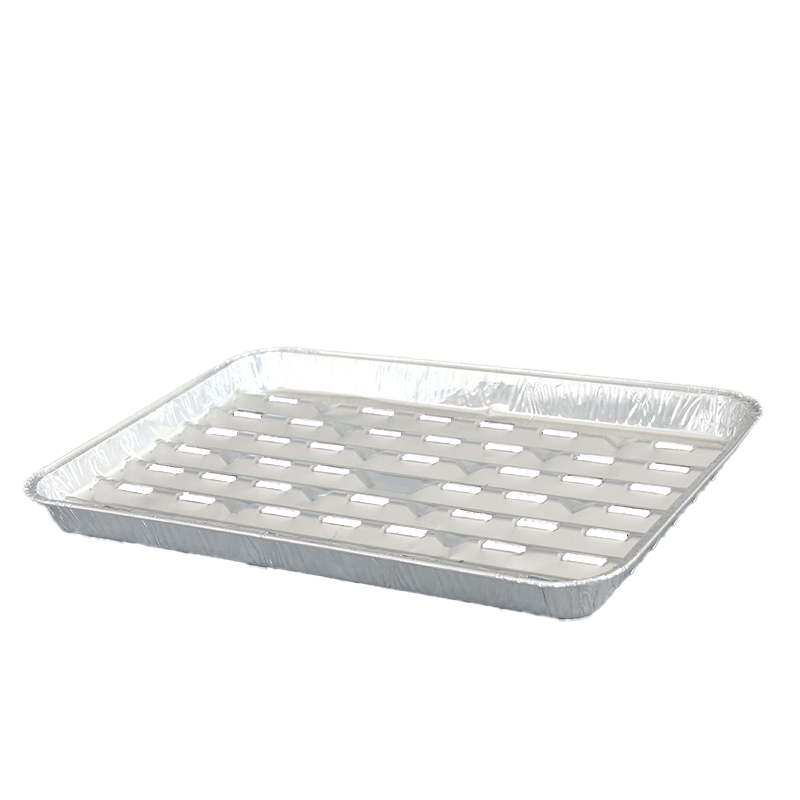
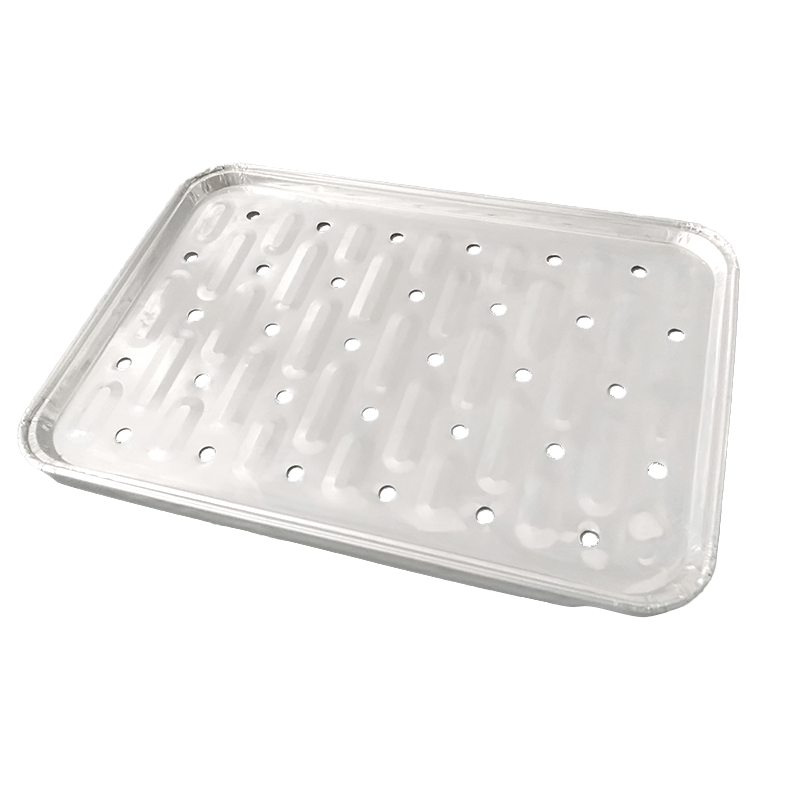
Ningbo Aikang Aluminum Foil Technology Co., Ltd is located in Haishu District, Ningbo, one of the most important port cities in China. The company is committed to the design, development, and production of environmentally disposable aluminum foil products and providing practical and advanced packaging solutions to meet the dynamic change of the market. The main products consist of aviation aluminum foil containers, barbecue pans, Turkey pans, aluminum loaf pans, and other varied aluminum foil containers.
Moreover, the company has developed several automatic production lines and molds to fully ensure the quality and diversity of the products. Equipped with professional design, advanced manufacturing facilities, and molds, qualified products, and a dedicated sales and service team, Aikang has ranked itself the top-notch enterprise in China. The company has and will always hold the principle of sincerity and integrity to provide the best products and service to the customers at home and abroad and finally create a double-win situation. Looking forward to your visit and the cooperation with your esteemed company.
Frequently asked questions
Q1. What is the standard size of a catering pan?
A1. The reference size is the full pan at 12 x 20 inches. Half, third, quarter, sixth and ninth pans are exact fractions of that same footprint, so they drop into one standard steam table well.
Q2. How many servings does a full-size catering pan hold?
A2. A full-size pan at 6 inches deep holds about 20 quarts. In practice, caterers plan roughly 10 to 12 servings of a saucy pasta and up to about 20 servings of a dense casserole from the same pan.
Q3. Can I use a half-size pan in a full-size steam table well?
A3. Yes. Two half pans fill one full-size well, and so do three third pans, four quarter pans, or one half pan plus two quarter pans. Just avoid layouts that leave a gap, because loose pans slide.
Q4. What depth catering pan should I choose for a buffet line?
A4. A 2.5 inch pan is enough for a topping or side served quickly, while 4 inch and 6 inch pans suit main dishes that must hold temperature through a long service. Deeper pans hold heat longer but weigh more when full.
Q5. Are aluminum foil catering pans as strong as stainless steel pans?
A5. No, and they are not meant to be. Foil pans are lighter and are usually supported by a rack or well. Their advantage is that they hold shape for one service and then leave with the food instead of being washed.
Q6. Do foil steam table pans fit standard lids?
A6. Full-size and half-size foil pans are formed to the same 12 x 20 inch family, so board lids, foil lids and sealing film made for that family generally fit. Confirm rim style and top-out dimensions with your supplier before ordering.
Choose AiKang for Top-Quality
Aluminum Foil Products
Explore Our
Featured Products

Ningbo Aikang Aluminum Foil Technology Co., Ltd, based in Ningbo, produces eco-friendly disposable aluminum foil products. They prioritize quality and customer satisfaction, serving the global market with innovative packaging solutions.


Quick Links
Contact
-
 No. 5 Yongxing East Road, Fengshan Street, Yuyao City, Zhejiang Province, China
-
 Tel: +86-15867468784
-
 E-mail: [email protected]
Send Us A Message
