
 English
 日本語
日本語 عربى
عربى Español
-
 01
01
Serving Tray Measurements: Standard Sizes, Depths, and Capacities Guide
Industry News-A catering kitchen orders 500 "large" foil serving trays. The trays fit the counter opening perfectly, but the lids sit too high for the transport cart, and part of the order has to be re-packed by hand. Nothing was wrong with the trays. Two teams were using the word "large" for two different measurements.
That is the whole problem in one sentence, and the solution is just as short. A serving tray is defined by three outside dimensions: length, width and depth. Measure length and width rim to rim, measure depth from the rim to the base, and confirm whether the figure you were quoted is a top-outside, top-inside or bottom dimension. Depth, not footprint, decides how much food the tray holds. The sections below show how those numbers behave in real kitchens, steam tables and delivery bags.
Content
- 1 The Three Numbers Behind Every Serving Tray Measurement
- 2 Standard Steam Table Pan Measurements
- 3 Depth Changes Capacity More Than Length Does
- 4 Footprint Area: The Number Most Buyers Skip
- 5 Oval and Round Serving Trays: Measure by Axis
- 6 Rectangular, Oblong and Compartment Trays
- 7 Gauge, Rim Profile and Lid Clearance
- 8 Tolerances and Unit Conversions to Confirm in Writing
- 9 A Short Checklist Before You Order
- 10 About Ningbo Aikang Aluminum Foil Technology Co., Ltd
- 11 Serving Tray Measurement FAQ
- 11.1 Q1. Are serving tray measurements taken at the top or the bottom?
- 11.2 Q2. What are standard full-size steam table pan measurements?
- 11.3 Q3. How much does a full-size pan actually hold?
- 11.4 Q4. How do I convert tray measurements from inches to millimetres?
- 11.5 Q5. Why does my oval tray hold less food than expected?
- 11.6 Q6. What tolerance should I ask for on foil serving trays?
The Three Numbers Behind Every Serving Tray Measurement
Foil trays are drawn from flat sheet, so they are always tapered. The rim is the widest part, the base is the narrowest, and the difference grows with depth. That single fact explains most measurement disputes.
- Top-outside length and width (rim to rim): decides whether a tray drops into a counter opening, a chafing dish frame or a cart slot.
- Top-inside: the usable serving surface, and the figure that matters when you are plating portions.
- Base dimensions: decides whether trays nest, stack and fit standard racks.
- Depth (rim to base): fixes capacity, lid clearance and how much the tray flexes when lifted full.
Because of the draw, the base of a deep tray is visibly smaller than its rim, enough that a tray can look undersized once it is filled and placed on a table. When someone tells you a tray is 500 mm long, the next question is always: measured where?
Standard Steam Table Pan Measurements
Most standard serving tray sizes in foodservice trace back to the steam table pan grid. Equipment makers publish these footprints as a fixed set, and the same numbers are reused for chafing dishes, prep tables and holding cabinets, so a tray that matches the grid fits almost any counter it meets.
| Pan size | Top-outside length | Top-outside width | Typical depths |
|---|---|---|---|
| Full size | 20.75 in (527 mm) | 12.75 in (324 mm) | 2.5, 4, 6, 8 in |
| Half size | 10.38 in (264 mm) | 12.75 in (324 mm) | 2.5, 4, 6 in |
| Third size | 6.88 in (175 mm) | 12.75 in (324 mm) | 2.5, 4, 6 in |
| Sixth size | 6.88 in (175 mm) | 6.38 in (162 mm) | 2.5, 4 in |
| Ninth size | 4.25 in (108 mm) | 6.88 in (175 mm) | 2.5, 4 in |
These are top-outside figures, so a 527 mm pan needs an opening slightly larger than 527 mm to drop in without scraping the frame. Depth availability is where suppliers differ most, and it is the first thing to confirm in writing: standard holding equipment accepts pans up to 6 inches deep, while anything deeper needs a well or cabinet built for it. Our full-size deep steam table pan is documented with its top-outside length, width and depth so the numbers can be checked against your counter before a production run is scheduled.
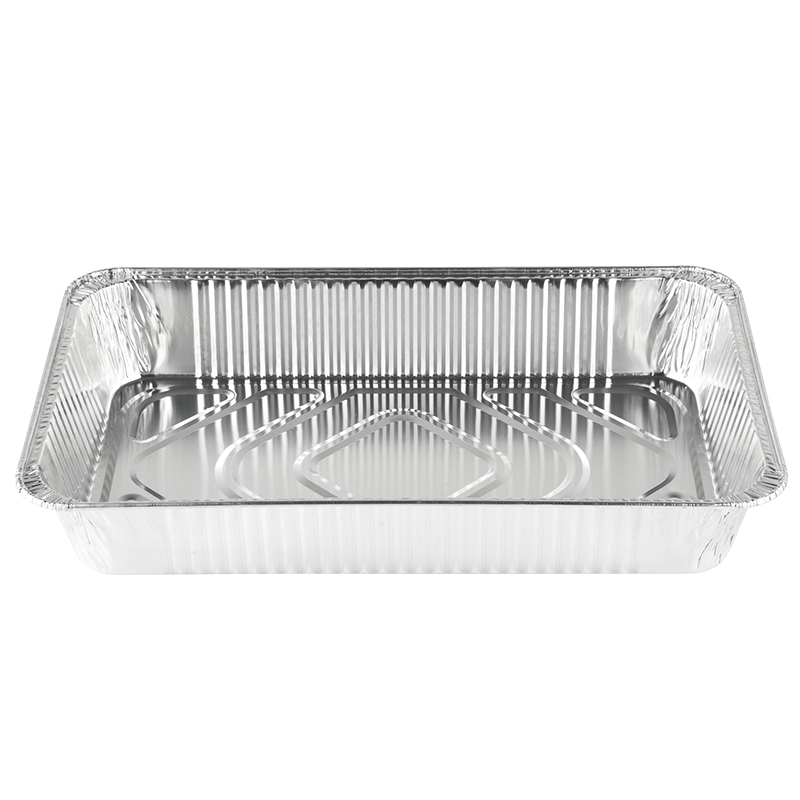 Full-Size Deep Steam Table Pan IK528Professional-grade design Advantages of deep design: The deep design of the Full-Size Deep Steam Table Pan IK528 provides it with greater capacity and flexibility, all...View Product →
Depth Changes Capacity More Than Length Does
Buyers often assume a bigger tray is a longer tray. On the same footprint, going from 2.5 to 4 inches deep adds roughly 60 percent more volume, because depth multiplies against a surface that is already large. Published catalog capacities for full-size pans follow that curve closely.
Half-size pans land near half of those figures: roughly 4, 6.5 and 10 quarts at 2.5, 4 and 6 inches. The practical caution is that deeper is not automatically better. A 6-inch pan sitting in a 4-inch well stands proud of the counter and blocks the sneeze guard, and a pan used for hand portioning is easier to serve from at 2.5 inches. Match depth to the holding equipment first, then choose capacity.
Footprint Area: The Number Most Buyers Skip
Two trays can share a length and still hold very different amounts, because width does the rest of the work. Multiplying top-outside length by width gives an area figure that is far more useful than either dimension alone when you compare formats.
A full-size pan covers about 265 square inches, a half-size about 132, a third-size about 88. For planning, a full-size pan at 4 inches deep holds roughly 100 half-cup portions of 4 fluid ounces, a number you can scale across the grid without recalculating volumes by hand.
Oval and Round Serving Trays: Measure by Axis
Oval trays are quoted differently, and this is where catalog descriptions cause the most confusion. An oval tray is defined by two axes: the major axis, tip to tip across the longest dimension, and the minor axis, across the widest point perpendicular to it. Because the walls curve inward at the ends, the flat base is shorter than the major axis, which is why a large oval can look generous on paper and tight once a whole fish or a long loaf is placed on it. Check the base, not the rim, when the food is long or irregular.
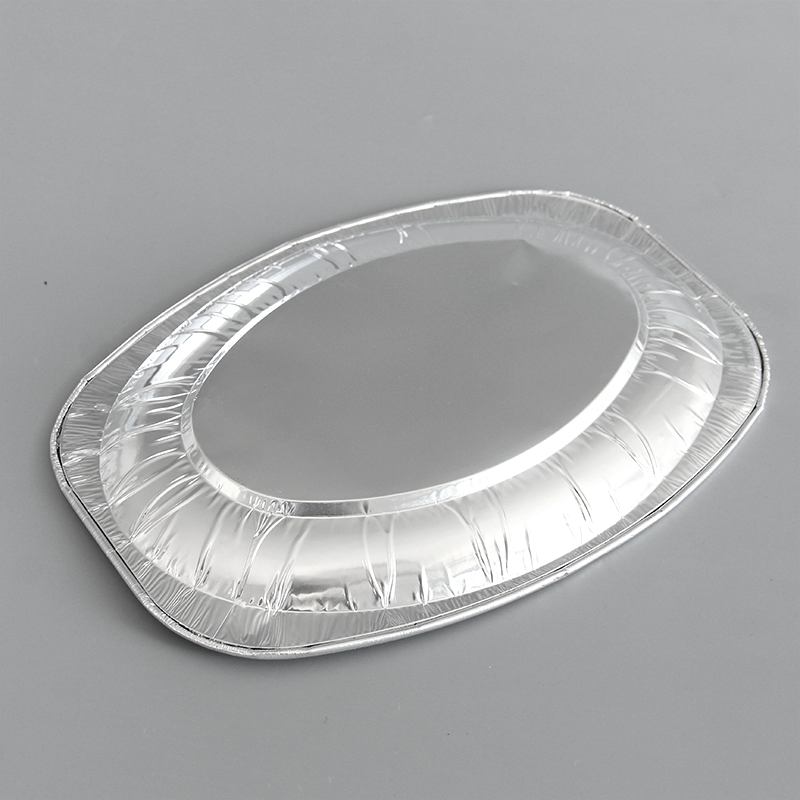 Large Oval Serving Tray IK550The Large Oval Serving Tray IK550 is a foil tray designed for serving large dishes, displaying banquet food, and providing elegant catering services. Unique oval desig...View Product →
Round trays are quoted by diameter, and it is worth asking whether that diameter is measured over the rim or at the base. Lids and covers are matched to the rim profile rather than to a generic size, so the diameter alone does not guarantee a fit.
Rectangular, Oblong and Compartment Trays
Oblong and rectangular formats are the workhorses for takeout, baking and barbecue, and their measurements follow the same rule: length and width rim to rim, depth rim to base. Capacity-based names such as 1000 ml or 2200 ml are useful shorthand, but they describe volume, not fit, so two 1000 ml trays from different tools can differ by several millimetres in length. Check the outside dimensions against your bag, liner or sealing machine before you rely on the millilitre figure. You can see the full set of footprints in our oblong and rectangular foil container range.
Compartment trays add one more variable: divider positions. The total length can be correct while the main compartment is too short for a sandwich or too narrow for a sauce cup. When ordering a 3- or 4-compartment tray, ask for the compartment split as a measurement, not just as a photograph.
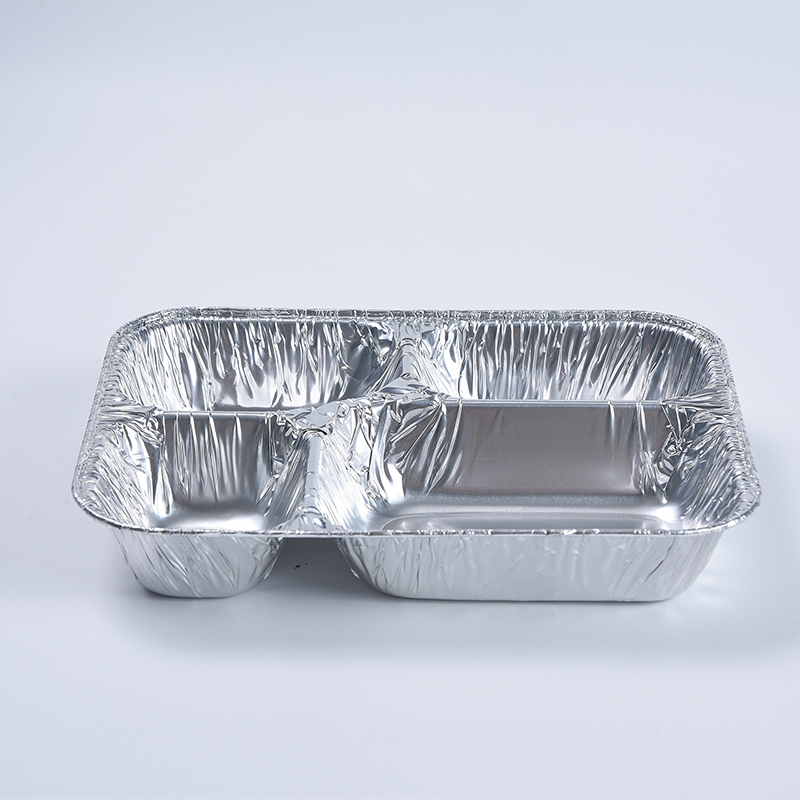 Oblong 4-Compartment Tray 227-4Innovative four-compartment design More choices and matching: The four-compartment design of Oblong 4-Compartment Tray 227-4 enables it to accommodate multiple dishes ...View Product →
Gauge, Rim Profile and Lid Clearance
Foil gauge does not change length or width, but it changes how a tray behaves at those dimensions. Light takeout containers are typically formed from 50 to 100 micron foil, while heavier roasting and steam table pans often run 100 to 150 microns so a loaded tray can be lifted without buckling. If a supplier quotes a heavy duty tray with no gauge figure, the number that actually affects your line is still missing.
Lids are a separate measurement again. A lid is matched to the rim profile, not to length and width alone, and it adds a few millimetres to the outer footprint plus roughly 5 to 10 mm to stack height. That is the gap that catches transport planners: the tray fits the cart, the lidded tray does not. Our food-grade foil trays are documented with lid compatibility for exactly this reason.
Tolerances and Unit Conversions to Confirm in Writing
Formed foil trays are commonly quoted with a variance of 1 to 2 mm on length and width. That is fine for most catering work and not fine for automated filling or sealing lines, where a 2 mm drift across a pallet stops production. If your equipment needs tighter, say so before tooling is cut rather than after the first shipment.
- 1 inch = 25.4 mm
- 1 quart = 0.946 litres = 32 US fluid ounces
- 1 US fluid ounce = 29.6 ml
- 1 pound of food by weight is roughly 454 g, which matters when a recipe is written by weight but the tray is sold by volume
A Short Checklist Before You Order
- Write down the opening, rack or bag the tray must fit, and its own tolerance.
- State clearly whether your figures are top-outside, top-inside or base dimensions.
- Confirm depth and, separately, the capacity in litres or quarts at that depth.
- For oval and round trays, give both axes, or the diameter plus where it was measured.
- Ask for the gauge and the forming variance in writing.
- Check lid compatibility and the stack height of the lidded tray.
- Order a sample and measure it with a caliper before the full run.
About Ningbo Aikang Aluminum Foil Technology Co., Ltd
Ningbo Aikang Aluminum Foil Technology Co., Ltd is located in Haishu District, Ningbo, one of the most important port cities in China. The company is committed to the design, development, and production of environmentally disposable aluminum foil products and providing practical and advanced packaging solutions to meet the dynamic change of the market. The main products consist of aviation aluminum foil containers, barbecue pans, Turkey pans, aluminum loaf pans, and other varied aluminum foil containers. Moreover, the company has developed several automatic production lines and molds to fully ensure the quality and diversity of the products. Equipped with professional design, advanced manufacturing facilities, and molds, qualified products, and a dedicated sales and service team, Aikang has ranked itself the top-notch enterprise in China.
The company has and will always hold the principle of " sincerity and integrity" to provide the best products and service to the customers at home and abroad and finally create a double-win situation. Looking forward to your visit and the cooperation with your esteemed company!
When a project needs a tray that is not on the standard grid, our design and mold team can quote the tooling and the measurement variance together, so the drawing and the delivered pallet match.
Serving Tray Measurement FAQ
Q1. Are serving tray measurements taken at the top or the bottom?
Catalog sizes are normally top-outside, measured rim to rim. The base is always smaller because drawn foil trays taper.
Q2. What are standard full-size steam table pan measurements?
About 20.75 x 12.75 inches (527 x 324 mm) top outside, offered in 2.5, 4, 6 and 8 inch depths.
Q3. How much does a full-size pan actually hold?
Roughly 8 quarts at 2.5 inches, 13 quarts at 4 inches and 26 quarts at 8 inches of depth.
Q4. How do I convert tray measurements from inches to millimetres?
Multiply inches by 25.4, so a 20.75 inch pan is 527 mm. A quart equals 0.946 litres.
Q5. Why does my oval tray hold less food than expected?
The usable base is shorter than the rim-to-rim major axis because the curved ends cut into the flat area.
Q6. What tolerance should I ask for on foil serving trays?
A variance of 1 to 2 mm on length and width is common. Tighter limits must be agreed before tooling is cut.
Choose AiKang for Top-Quality
Aluminum Foil Products
Explore Our
Featured Products

Ningbo Aikang Aluminum Foil Technology Co., Ltd, based in Ningbo, produces eco-friendly disposable aluminum foil products. They prioritize quality and customer satisfaction, serving the global market with innovative packaging solutions.


Quick Links
Contact
-
 No. 5 Yongxing East Road, Fengshan Street, Yuyao City, Zhejiang Province, China
-
 Tel: +86-15867468784
-
 E-mail: [email protected]
Send Us A Message
