
 English
 日本語
 عربى
 Español

-
 01
Lightweight Aluminium Tins for Food Packaging: Weight, Barrier and Cost Benefits
Industry News-When a distributor compares an 850 ml aluminium foil entrée container with a rigid plastic tub of the same fill volume, the quotation sheet rarely settles the decision. The figure that does is landed cost per thousand units, and container mass sits near the center of that calculation, next to cube, pallet pattern and breakage rate.
Lightweight aluminium tins hold their ground in food packaging for three reasons that survive technical scrutiny: very low mass per unit, an effective barrier against light, moisture, oxygen and aroma, and heat tolerance that most polymers cannot approach. The trade-offs are just as real — gauge selection, rim flatness for lidding, and a microwave caution that belongs on the pack rather than in a footnote.
Content
- 1 Where the Weight Savings Actually Land
- 2 Why a Thin Aluminium Wall Still Protects the Food
- 3 How Lightweight Aluminium Compares with Plastic and Molded Fiber
- 4 Structure, Gauge and the Parts That Do the Work
- 5 Oven, Freezer and the Microwave Caveat
- 6 Sustainability Claims Buyers Can Actually Defend
- 7 A Buyer's Checklist for Lightweight Aluminium Tins
- 8 Frequently Asked Questions
- 8.1 Q1. Are aluminium tins lighter than plastic containers?
- 8.2 Q2. What foil thickness should I specify?
- 8.3 Q3. Can lightweight foil containers be sealed with lidding film?
- 8.4 Q4. Are they safe for oven and freezer use?
- 8.5 Q5. Do acidic or salty foods react with aluminium?
- 8.6 Q6. Can I order custom sizes, compartments and branding?
Where the Weight Savings Actually Land
Aluminium has a density of about 2.7 g/cm³, roughly one-third that of steel and lower than the filled polymers used in most rigid food tubs. A formed foil container carries only the metal its walls need, so a takeaway entrée tray weighs a matter of grams rather than tens of grams, and a nested sleeve of a thousand units takes a fraction of the cube that stacked rigid tubs demand.
Weight, however, does not automatically convert into freight savings. For low-density packaging, carriers usually bill on volumetric or dimensional weight, so a light but bulky carton can cost the same as a heavier compact one. The savings appear where mass is the binding constraint:
- Air freight of chilled or frozen ready meals, where every kilogram is charged at a premium.
- Airline and rail catering, where galley loading weight is managed continuously across a network.
- Parcel and meal-kit fulfillment, where outer cartons must stay below carrier weight bands.
- Manual handling on high-throughput packing lines, where lighter trays reduce operator fatigue and repetitive-strain risk.
The practical lesson for buyers is to model freight on the packed pallet, not on the empty container. Nesting ratio, carton dimensions and pallet height usually move the landed cost more than a tenth of a millimeter of foil gauge.
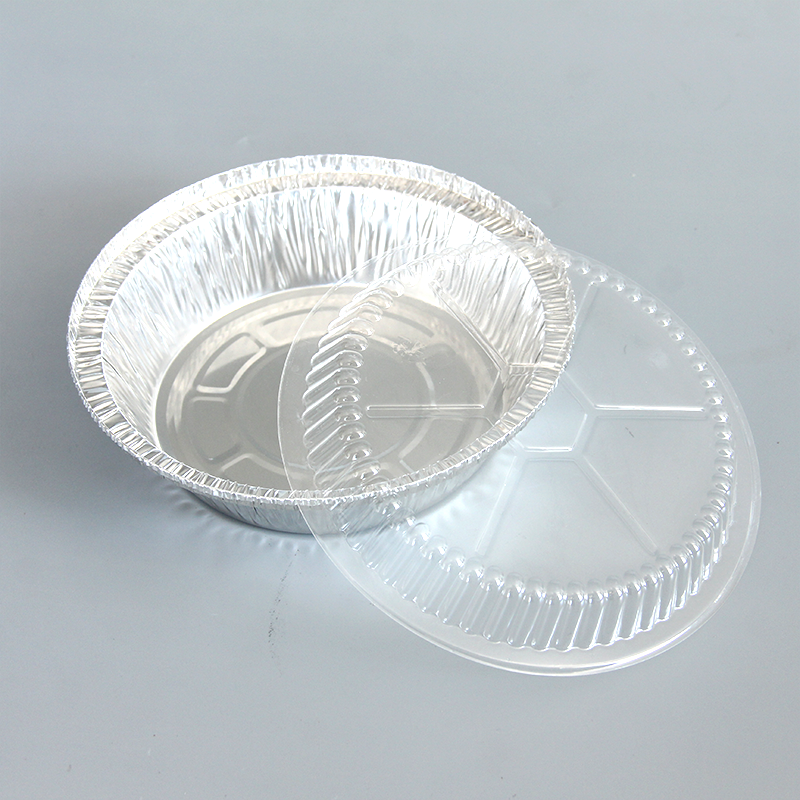 7-Inch Round Aluminum Foil Take-Out Container IK182A 700 ml round foil container for takeaway and oven use, with oil-proof walls and an optional PS lid for transport.View Product →
Why a Thin Aluminium Wall Still Protects the Food
Foil behaves differently from paper or molded fiber because the barrier comes from the metal itself rather than from a coating. Once the gauge is above the range where pinholes appear under normal handling, the wall stops light completely and resists the passage of water vapor, oxygen and grease. That combination explains why a foil tray keeps fried food crisp, limits freezer burn, and stops strong aromas from migrating into neighboring products in the same case.
Grease resistance matters more than most specifications suggest. Barbecue, curry, butter-based bakery items and roasted meats all release hot fat that will wick through fiber-based packaging within minutes. A metal wall has no fiber to wick into.
The barrier only holds if the lid holds. Seal strength depends on three variables working together: rim flatness after forming, alloy temper (which governs how the rim springs back), and the compatibility of the lidding film or heat-seal lacquer with the container surface. Buyers running automated sealers should send production samples to the film supplier before committing to a gauge, because a rim that seals perfectly at 0.09 mm may leak at 0.06 mm.
Food-contact documentation should state the alloy, gauge, coating and the regulation the material is declared against. Reputable suppliers of food-grade aluminum foil trays will issue this as a standard part of the quotation, not as a special request.
How Lightweight Aluminium Compares with Plastic and Molded Fiber
The comparison is rarely a clean win on every row. Each material leads on something.
| Property | Aluminium foil container | Polypropylene container | Molded fiber tray |
|---|---|---|---|
| Light and oxygen barrier | Complete at normal gauges | Moderate; oxygen transmission is measurable | Limited, and humidity-dependent |
| Grease resistance | Inherent, no coating needed | Inherent | Requires a barrier liner or additive |
| Service temperature | Well above normal oven temperatures | Typically around 100–120 °C | Dry heat to roughly 200 °C; weakens when wet |
| Rigidity per gram | High once ribs and corner radii are formed | Moderate | Moderate when dry, low when damp |
| End-of-life route | Recyclable where clean foil is accepted | Widely collected, often downcycled | Industrial composting; limited recycling |
Choose foil when the product is hot-filled, oven-finished, frozen for months, or sold into a market where plastic restrictions are tightening. Choose plastic when transparency is a merchandising requirement. Choose fiber when the brand story depends on a compostable claim and the food is dry or short-shelf-life.
Structure, Gauge and the Parts That Do the Work
A foil container is a shallow drawn part, and its stiffness comes from geometry as much as from thickness. The rim, the sidewall taper, the corner radii and any embossed ribs all contribute to how the tray behaves when stacked six high in a carton.
Gauge is the specification buyers argue over most. The table below shows indicative ranges; final selection should follow your own stacking, drop and oven tests.
| Container type | Typical gauge | Common alloys | What drives the choice |
|---|---|---|---|
| Takeaway entrée container, 500–1000 ml | 0.06–0.09 mm | 3003, 8011 | Stacking strength and lidding seal |
| Bowl or soup cup | 0.07–0.10 mm | 3003 | Hoop strength and seam integrity |
| Baking, roasting and barbecue tray | 0.09–0.15 mm | 3003, 3004 | Load bearing while hot |
| Steam table pan | 0.10–0.16 mm | 3003 | Repeated handling and wet steam |
Alloy choice follows the same logic. Manganese-bearing 3003 gives a good balance of strength and formability; 3004 adds strength for large pans; 8011 is common for general tableware and lidding stock. Temper H22 or H24 is usual for formed containers, while fully soft temper suits wrapping foil. Going thinner than about 0.05 mm in a stacked takeaway tray usually costs more in damage claims than it saves in metal.
 850 ml Oblong Aluminum Foil Container IK220SA food-safe 850 ml rectangular foil container with wide base and flat walls for takeaway mains, sides, and baked goods.View Product →
Oven, Freezer and the Microwave Caveat
Foil has no service-temperature problem in a domestic or commercial oven; the limit is the food and the handling, not the metal. Used under a grill or over an open flame, thin foil can distort or puncture, so direct flame contact should be ruled out in the usage instructions. In a convection oven the tray also conducts heat from the walls, which browns edges and bases faster than a ceramic dish — a point worth flagging to customers moving a recipe across from glass.
Freezer performance is straightforward: aluminium does not embrittle at domestic or blast-freezer temperatures, and the barrier prevents the moisture loss that causes surface dehydration. The container must be lidded, though, because an open tray in a forced-air freezer will still dry out from the exposed surface.
Microwave use is where honest labeling pays. Foil reflects microwaves, and thin edges, corners or a wall touching the cavity can arc. Some authorities permit small, smooth pieces of foil in a microwave when they are kept well away from the walls, but a deep foil container with a wide rim is a different risk profile. The safe recommendation for prepared meals is to decant, or to sell the product in a container the customer can put straight into a conventional oven. Our larger
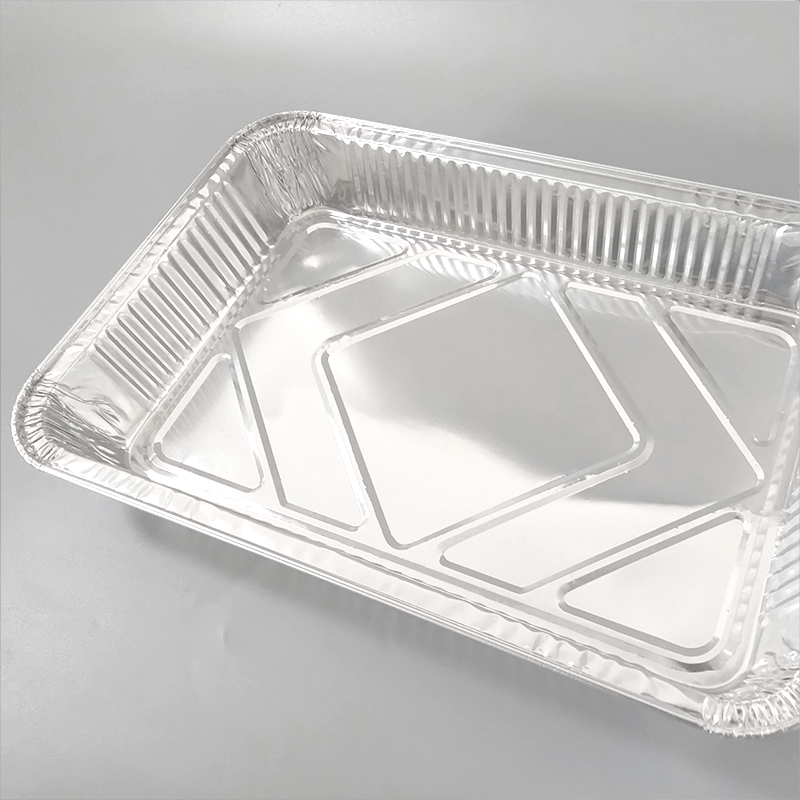 2200 ml Oblong Aluminum Foil Pan IK315-2A large 2200 ml foil pan for oven baking, roasting, and catering batches, with stackable walls and even heat distribution.View Product →
roasting pans are typically specified for oven and holding-cabinet use rather than microwave reheating.
Sustainability Claims Buyers Can Actually Defend
Aluminium is recyclable without loss of quality, and secondary production is widely cited by the International Aluminium Institute and other industry bodies as requiring roughly 95 percent less energy than primary smelting. That is a strong story, but it only holds if the material re-enters a recycling stream.
Thin and food-soiled foil is the weak point. Many municipal programs exclude foil smaller than a certain size, and grease contamination can disqualify a batch. Buyers should therefore avoid blanket "100% recycled" or "fully circular" statements and instead publish what is defensible:
- The alloy and gauge, so recyclers and customers can classify the item.
- A market-specific recyclability statement rather than a global one.
- Confirmation that the container is mono-material, with no laminated plastic layer that would complicate separation.
- Lightweighting data, since using less metal per unit is a measurable reduction at the material level.
Regulation is moving in the same direction. The EU Packaging and Packaging Waste Regulation introduces recyclability-by-design and recycled-content obligations that will phase in over the coming years, and buyers selling into Europe are already asking suppliers for documentation ahead of those deadlines.
A Buyer's Checklist for Lightweight Aluminium Tins
- Define the load, not just the volume. State the filled weight, stack height and expected drop height before discussing gauge.
- Set gauge with a tolerance band, and ask how the supplier verifies it — micrometer checks on the coil or on the formed part.
- Confirm alloy and temper in writing, because two suppliers quoting "3003" may deliver different tempers and different rim stiffness.
- Send your lidding film or sealer settings to the factory so rim dimensions can be matched before tooling is cut.
- Request a food-contact declaration for the destination market, covering alloy, coating and any lacquer.
- Run your own oven, freezer and handling trial. A supplier's laboratory result does not predict how your staff will treat a tray at 3 a.m.
- Agree packing details: nested count per sleeve, carton dimensions, pallet pattern. These settings decide the dimensional weight you will actually pay for.
- Discuss OEM and ODM early if you need custom capacities, compartment layouts or embossed branding, since tooling lead time drives the launch date.
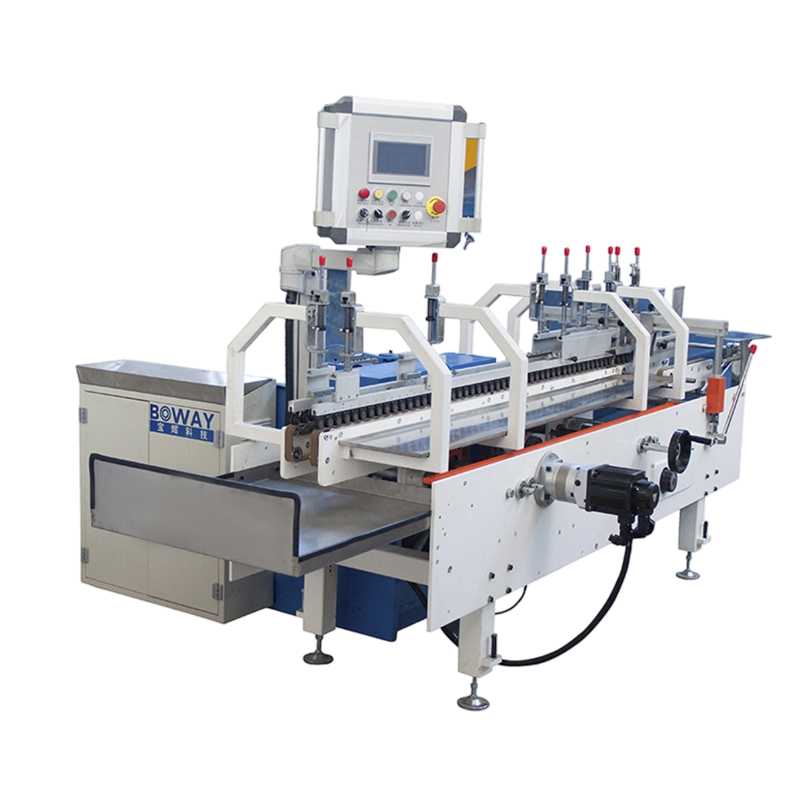
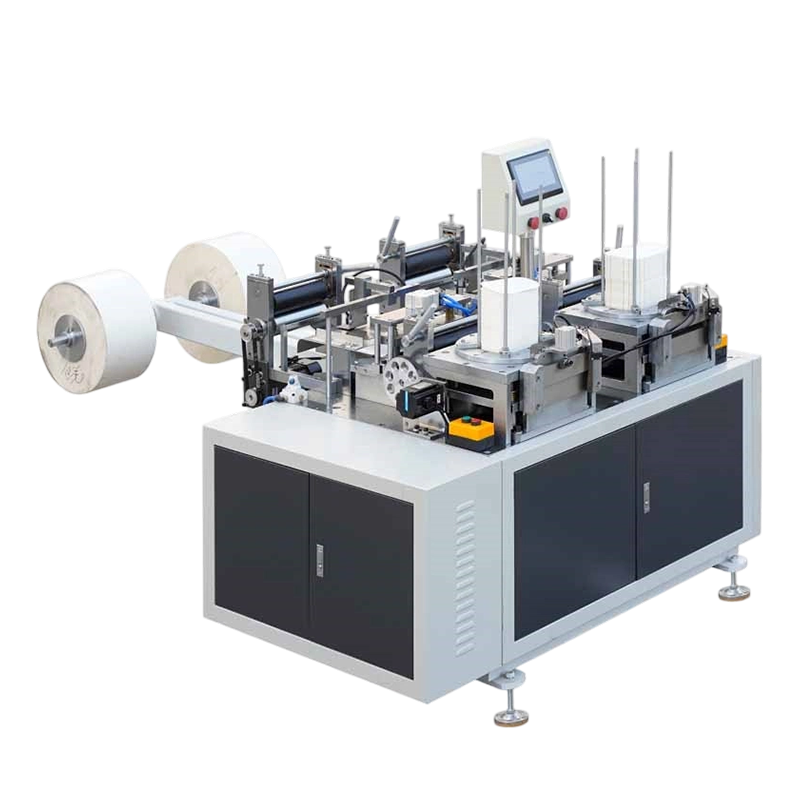
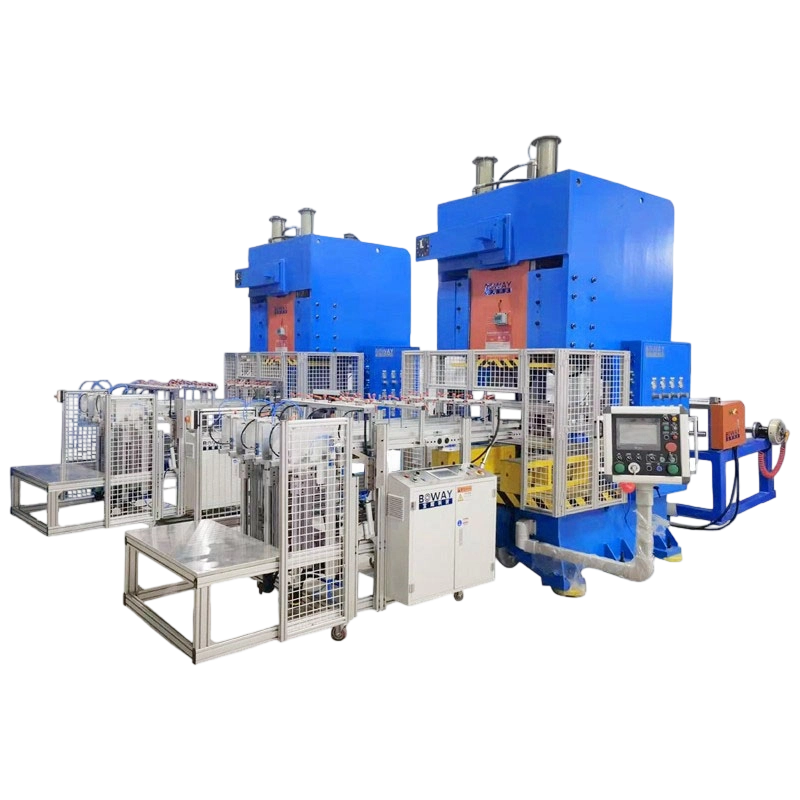
Supplier evaluation should go beyond the sample. Ask whether the factory forms its own tooling, how it controls gauge consistency across a production run, and what in-line inspection catches rim deformation before cartoning. A manufacturer that also builds foil container production equipment tends to understand those variables from both sides of the machine — Ningbo Aikang Aluminum Foil Technology supplies formed tableware and the production lines behind it, which is useful when a specification has to be tightened quickly. For capacity planning across formats, this aluminum foil container size guide covers the common volume steps.
Frequently Asked Questions
Q1. Are aluminium tins lighter than plastic containers?
Per unit, usually yes, because the wall is a thin metal sheet rather than a molded polymer section. But weight alone does not decide freight cost — compare the packed pallet, including nesting ratio and carton cube.
Q2. What foil thickness should I specify?
Most takeaway entrée trays sit between 0.06 and 0.09 mm, while roasting and steam table pans run heavier. Final gauge depends on filled weight, stack height and whether the tray goes into an oven.
Q3. Can lightweight foil containers be sealed with lidding film?
Yes, provided the rim is flat and the film is matched to the container surface. Seal strength is governed by rim geometry, alloy temper and film specification, so trial sealing before mass production is essential.
Q4. Are they safe for oven and freezer use?
Yes for conventional ovens and freezers within normal food-service temperatures. Direct flame and grill-element contact should be avoided, and microwave use should follow the manufacturer's statement rather than assumption.
Q5. Do acidic or salty foods react with aluminium?
Acidic and heavily salted foods can interact with bare aluminium, particularly during long storage. Where that risk exists, specify a lacquered container or shorten the intended holding time, and confirm the food-contact declaration covers the application.
Q6. Can I order custom sizes, compartments and branding?
Yes. Custom capacities, multi-compartment layouts and embossed or printed branding are available through OEM and ODM programs. Minimum order quantities, tooling cost and lead time depend on the design, so they are confirmed per project.
If you are weighing a switch to lightweight aluminium tins, the fastest route to a reliable answer is a specification conversation rather than a catalog browse. Send the fill volume, filled weight, oven or freezer exposure, sealing method and target market, and a manufacturer can come back with a recommended gauge, alloy and tooling plan — plus samples to test on your own line.
Choose AiKang for Top-Quality
Aluminum Foil Products
Explore Our
Featured Products

Ningbo Aikang Aluminum Foil Technology Co., Ltd, based in Ningbo, produces eco-friendly disposable aluminum foil products. They prioritize quality and customer satisfaction, serving the global market with innovative packaging solutions.


Quick Links
Contact
-
 No. 5 Yongxing East Road, Fengshan Street, Yuyao City, Zhejiang Province, China
-
 Tel: +86-15867468784
-
 E-mail: [email protected]
Send Us A Message
